Due to special circumstances we have had to move our night from the traditional Thursday to the first Wednesday in November. Just this once so mark it in yer diary. We'll be back to Thursdays thereafter.
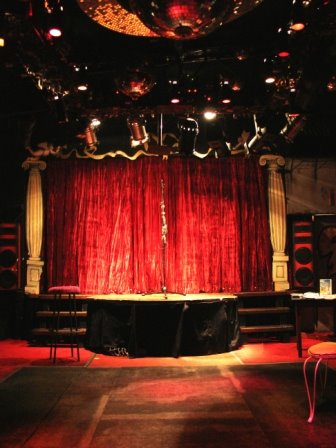
Al's Bar, 31 Dundas St


I'm not myself when you're not here
I'm in this holding pattern...
into the heartland
home, where the hope still stands
awaiting return...
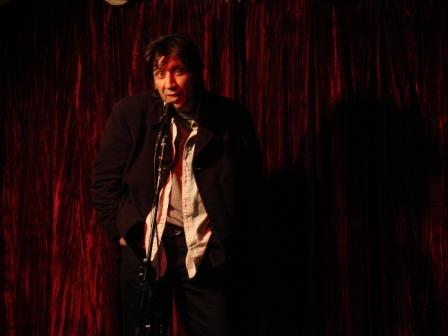
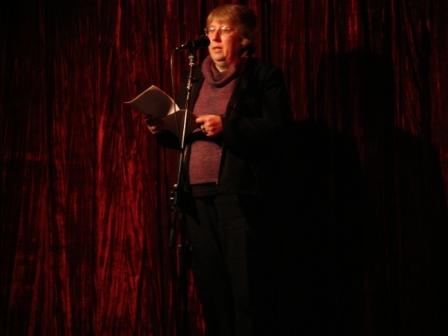
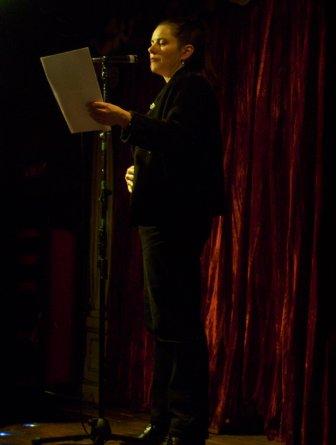
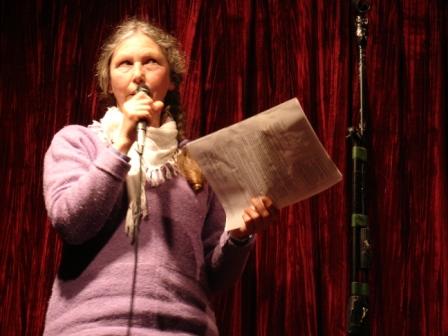
Canterbury Poets present Poetry in Performance Autumn Readings 2007

“One thing we as poets can do is build stronger intercultural bridges. The better we know and talk with one another, locally and internationally, the more difficult misunderstanding becomes.”
“Inasmuch as our work demands the reinvention of ourselves, we must also thereby reinvent our country. And the world. Imagine a world without war.”
-- Sam Hamill
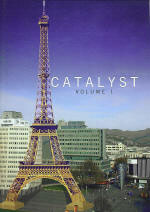
This landmark 5th issue of Catalyst celebrates a United Nations of literature in its many forms. With poet and founder of Poets Against War Sam Hamill as feature writer, a haiku sequence from Ban’ya Natsuishi, the President of the World Haiku Association, a selection of Bengali Poets, including prominent Indian poet Prabal Kumar Basu and a special section of poetry from ten Cuban Poets. All this and work from more international writers, cross pollinated with established and emerging voices from all over New Zealand.
Last year I had the honor and great pleasure of participating in the Third Wellington International Poetry Festival with Sam, Ban’ya, Prabal and a cast of fine
Poetry is an important bridge. Our poetry absolutely blossomed in the last century, in a very large part thanks to the influence of poetry from all over the world. That cross-pollination is essential to us and to our allied poets abroad. We need to know what every "they" have to say. We need to reaffirm ancient values and the practice of compassion. We need to remind people lost in materialist culture that, yes, poetry matters—just as it always has. Maybe even more, because it crosses boundaries more efficiently than ever before.”
- Sam Hamill

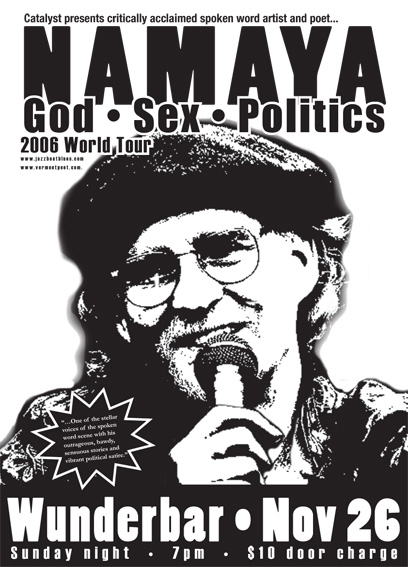
“…One of the stellar voices of the spoken word scene with his outrageous, bawdy, sensuous stories and vibrant political satire.”

We want to celebrate and showcase the brilliant writing talent we have, to support new and upcoming writers in our country, to tap into the pride we feel in our literary landscape and show you that whatever your taste, there’s a fantastic New Zealand book for you. We envisage NZ Book Month to be an annual event, which will grow over time to be a nation-wide festival involving everyone from local communities to the Prime Minister.
Fabulous Prizes!
The poetry ran the gamut from epic diatribes, acapella song, political rant, new age symbolism to rap and feminism. And speaking of epic feminism a word must be said about the dynamic duo of co-hosts (us) who did their best to whip the audience into a frenzy of bloodlusting, poet-burning fervour. Alas, no poets were harmed in the making of Poetry Idol but do we know how to waffle on or what?!! Making a meal fit for a giant can of tomatoes, Doc and Kez announced the results after a vibrant open mic consisting of last years runner up, calypso singing and some earlier Idol contestants. And now, drum roll please...
The Results
Poetry Idol 2006 - Rebecca Reider
Runner Up - Marissa Johnpillai
3rd Place - Sam Warland
4th - Tim Wildermoth
5th - Ricky Madibela
Photos to follow!
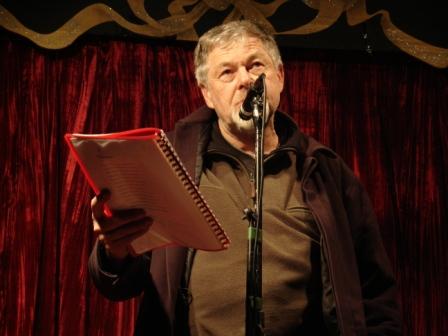
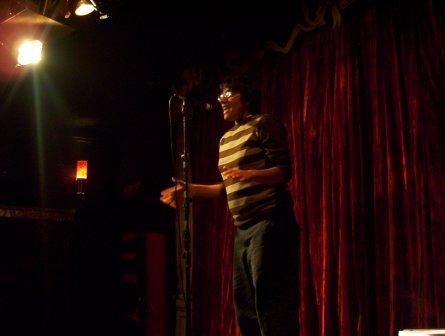
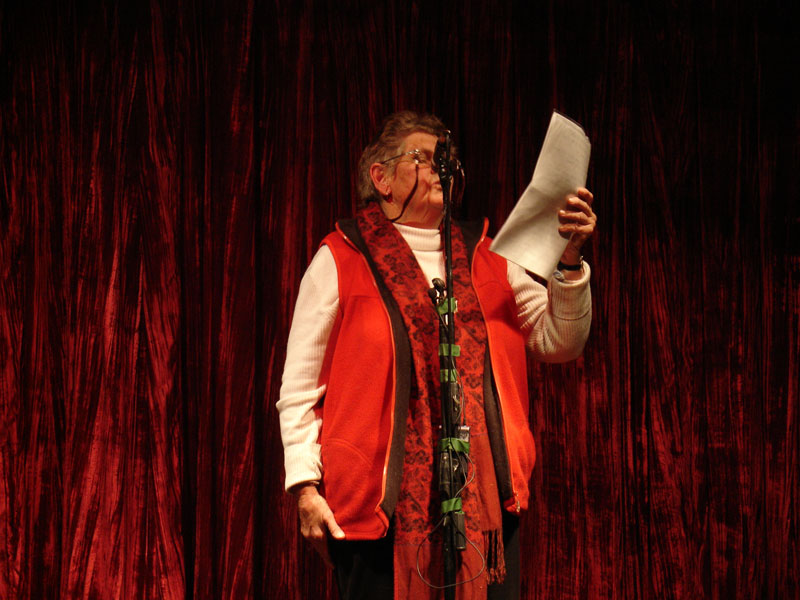
Ricky roared and (w)riggled into the audience's favour while Rosemary relied on regaling the audience with the 'vibe'.
Round Two is complete and while we always say to expect the unexpected, no-one foresaw the two poet head-to-head that we had last night.
Round One on Thursday 27th July was a bustling affair with nearly a full entry card and some pretty fierce action. Eventually the audience's favourite was revealed and Rebecca Reider became the first finalist to add her name to the golden list for the Grand Final.
Round Two as mentioned was a strange one as a small but vocal audience watched just two poets vie for the next place on the list. Rosemary Scott and Ricky Madibela went head to head while the supportive audience cheered them on. So on a night where no-one went home without a prize, Ricky Madibela was the winner and the next poet to go through to the Grand Final on August 31, while Rosemary vowed revenge and stating her intent to re-enter the next round - look out!
Is there something about the letter R?
... just when you thought it was safe to go back on the open mic...
WANTED: Poets with a stout heart, fierce, fearless and, where appropriate, balls of steel...
ALSO WANTED: Audience - must be prepared to judge, fair or harsh with a good ear and a light heart.
Oh yes you better believe it, Poetry Idol makes it's wintery way back to the Wunderbar for more literary hijinks, heartbreak n' hilarity. Last year the mic was furiously fought over by a whole horde of poets and the mighty Cris Fulton swept the stage and claimed the title (and a small wooden windmill trophy).
Who will it be this time? Do you have what it takes? Or do you want to be among the judges?
We want to see blood on the microphone! Tears before bedtime!
It's Catalyst's Poetry Idol: be prepared to entertain, stimulate, provoke, or move. Literally.
THE DATES:
Round One: Thursday 27th July, 8pm
Round Two: Thursday 3rd August, 8pm
Round Three: Thursday 10th August, 8pm
Round Four: Thursday 17th August, 8pm
Round Five: Thursday 24th August, 8pm
Grand Final: Thursday 31st August, 8pm - featuring the five round winners in a knockdown, drag out, no-holds-barred, deathmatch!
Registration for each round starts at 8pm, first 10 poets only. As always the audience is the judge, jury (and maybe even executioners...)
We expect to see you ALL there. Yes, (wait for it) you know you want to
Doors Open 7pm 
That's right, BYO poetry, prose, lyrics, rants, etc.
Come, listen, share, enjoy!
8pm at the Wunderbar, Lyttelton this Thursday (20/10/05)
click the Wunderbar link in the sidebar for location details.
As always, copies of Catalyst and other fine Neoismist Press books will be available for purchase including the latest release: Porno Ku XXX
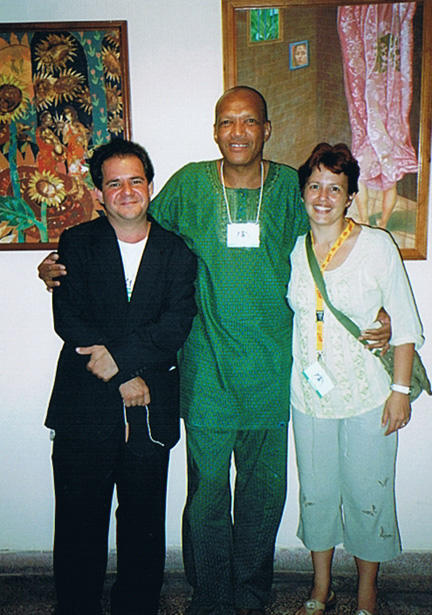
Above: Lewis Scott, Marlene Banbury (festival guide), Manuel Garcia Verdecia (poet & UNEAC vice-president)
Above: Children rapping on The Promenade in Havana.
UNION OF WRITERS AND ARTISTS OF CUBA
The president of UNEAC’s Holguin branch is the well-known painter Jorge Hidalgo and the two vice-presidents are Eugenio Marron and Manuel Garcia Verdecia. Both are well-known poets, both nationally and internationally.
The UNEAC building was where the poets, writers and painters presented their work over the course of the festival. Most of the artists were under the age of 30 and their minds were wide open to the experiences and ideas of their fellow participants. It should be understood that many of the artists were from countries in the Americas where the government does not take kindly to artists speaking "negatively" about the government or its leaders.
I spent most of my time with the Cuban poets and one in particular, the aforementioned Manuel Garcia Verdecia, professor of Cuban literature and prolific poet/writer and translator. He has translated the work of writers such as Alice Walker and Sylvia Plath into Spanish. We hung out together partly because he read my poems in Spanish at my readings and has translated some of my work for Spanish magazines but also because, as he said and I felt, "we seemed to have known each other from before".
Manuel's love of Cuba and its culture and history is beyond doubt. We did not talk directly of the current political state of Cuba. Rather, we talked of literature in general and in particular he wanted to know about the writers of New Zealand and Australia and what they were writing. He also was aware of some of the history of New Zealand and Australia and wanted to know how it was politically and socially for the indigenous peoples. He enquired as to how the cultures interacted.
Unlike many Cuban writers, Manuel has travelled outside of Cuba to western countries. Cuban writers generally do not have ready access to information about new trends in literature. He pointed out that while Cuban people have a vitality and flow in their daily lives, the poets read their poems in a very formal manner. As he said, Cuban poets have had little exposure to things such as "performance poetry".
As a poet and teacher, Manuel realises that much of the world is not aware that the arts are a strong part of daily life in Cuba and that the government plays a major role in this regard. As a vice-president of UNEAC, his dream is to create an opening for Cuban artists to have a wider audience. To bring that to fruition, he is presently translating the work of ten Cuban poets into English and hopes to have their work published in New Zealand, Australia and elsewhere.
HAVANA
After the festival in Holguin, my friend Manuel Garcia Verdecia gave me a contact name for the UNEAC branch in Havana. I took an overnight bus and headed for the capital city of Cuba. My contact person in Havana was Mr. Alex Pausidis, poet and vice-president of UNEAC’s Havana branch. When we met we had a long talk about poetry and New Zealand and Australian writers. He gave me copies of his poetry and that of the great Chilean poet, Pablo Neruda and another Cuban poet, Tito Junco. Alex also arranged for me to attend various poetry readings around Havana.
Between the poetry readings I visited some of Havana’s sights. First was the Museo de la Revolucion. The museum displays the history and artefacts of The Cuban Revolution and outside one can see the boat in which Fidel Castro sailed from Mexico back to Cuba in 1956. From there I went to the Museo Nacional de Bellas Artes, which houses Cuban art from the 16th century through to contemporary work. A short distance away was the Capitolio Nacional. This lovely architectural feat is a copy of Washington’s Capitol building but is richer in detail. The building was commissioned by the US-backed dictator Gerardo Machado in 1929 and cost US$17million. I also visited the house of one of Cuba’s national heroes, poet and liberator Jose Marti. And yes, I did end my sightseeing with a pilgrimage to La Bodeguita del Medio for a mojito. La Bodeguita del Medio is one of the bars Hemingway made famous and a mojito is a strong rum-based drink.
During my three weeks in Cuba I met poets, writers, painters and musicians as well as people on the street going about their daily lives. There is much in Cuba that one can see and hear, and there is much that one cannot. I am a person who believes (and history has shown it time and again) that the human spirit is a wondrous seed – and the hand of oppression may slow its growth, but not its flowering.
As I was getting ready to leave Cuba, one of the Mexican poets I had met, Leticia Herrera, said to me, “In October we’re having a festival of poets and writers in Monterey, Mexico – do you think you will be able to come?” I told her, “October is my month!”